
Reducing Wildfire Risk.
Protecting Reliable Power.
Wildfire risk is part of life across Beadle, Hand and Hyde, and portions of Miner, Spink, Kingsbury, Faulk, Buffalo, and Sully counties in South Dakota. Our Wildfire Mitigation Plan lays out the steady, year-round work, including inspection, vegetation management, weather monitoring, and coordination with local responders, that keeps the grid resilient and our neighbors protected.
3
COUNTIES SERVED
Hand • Hyde • Beadle2,532
MILES OF LINE
Inspected on rotating cycles
3 yr.
VEGETATION CYCLE
Right-of-way maintenance rotation
24/7
WEATHER WATCH
Red-flag day protocols active
Six lines of defense.
Dakota Energy’s wildfire mitigation approach is built on ongoing work across multiple areas of system maintenance, monitoring, and response to reduce risk and improve reliability.
01Risk AssessmentWe evaluate wildfire exposure across the service territory using the FEMA National Risk Index, USDA Forest Service wildfire-likelihood data, and U.S. Fire Administration Wildland- Urban Interface community maps to identify areas of elevated exposure across our service territory. This includes evaluating where electric infrastructure overlaps with higher-risk terrain, vegetation, and weather patterns to help guide mitigation efforts. |
02Vegetation ManagementRights-of-way are cleared and maintained on a rotating cycle, with priority given to spans crossing grassland fire-danger corridors. Trim, mow, and targeted removal happen ahead of fire-weather season. |
03System InspectionsA layered inspection program covers wood pole condition, line hardware, underground equipment and enclosures, and substations, catching wear, damage, and ignition risks before they fail in the field. |
04Weather and Fire Risk MonitoringOperations staff track the East River Grassland Fire Danger Index, National Weather Service red-flag warnings, fuel-moisture readings, and wind forecasts daily. Elevated conditions trigger tighter operating protocols. |
05Asset Maintenance & System ImprovementsDakota Energy reduces wildfire risk through risk-based asset maintenance and targeted infrastructure improvements. Aging equipment is repaired or replaced as needed to improve system reliability and minimize potential ignition sources. |
06Cooperative ResponseTrained staff are prepared to report fires, coordinate with local responders, communicate with members and the community, manage outages caused by fire, and document conditions after an incident for review and continuous improvement. |
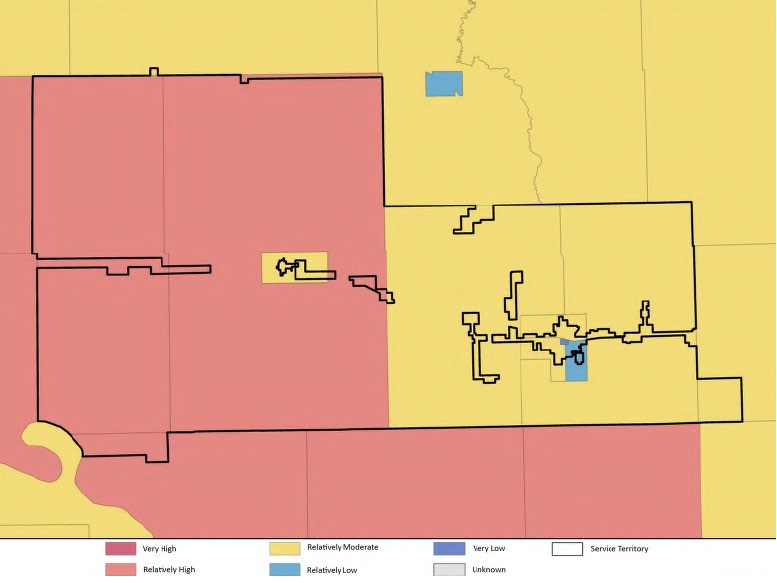
Wildfire risk
across our
service territory.
Wildfire risk varies across the region. Understanding where higher-risk conditions exist helps guide inspections, vegetation management, and system improvements.
THE FULL DOCUMENT
Read the Wildfire Mitigation Plan in full.
The complete plan covers our risk assessment, inspection schedules, operational protocols on red-flag days, and the communication framework members can expect during an active incident.
REPORT A HAZARD
See sparks, smoke, or a downed line? Call us immediately at (605) 352-8591, day or night, and then call 911 if there is active fire.
Questions about outage readiness, backup power, or medical equipment planning? Our team can walk you through it.